Easy Distortion settings
It is fairly easy to achieve a distorted sound from most guitar
amplifiers. If your amplifier has separate gain and volume controls, it
should be quite simple. Make sure your guitar is plugged into the amp
and the volume on the guitar is at 100%. Turn the volume control on the amp all
the way down, turn the gain control up to 75%, then turn the volume
control up until you achieve the desired volume level.
The tone of the
guitar should be distorted. If your amp has tone controls you can turn
up the mid to hear the distortion more clearly, or if your amp only had
bass and treble controls, you can turn both of those down a little to
hear more distortion. Adjusting the gain control will give you more or
less distortion. Your guitar volume knob will also give you some control over the sound of the distortion, as will the pickup selector switches and tone controls.
Types of Distortion
Depending on the sound of the distortion, you may classify it as
Overdrive, Distortion, Fuzz, Crunch, Clipping etc. The style of music
is also used to describe the sound, especially by manufacturers of
effect pedals..Blues, Grunge, Metal, etc. It is all the same thing
applied in various degrees.
Multi Channel Amps
Many amps have separate channels to facilitate an easy switch from
clean to distorted playing. Some have two or more
completely independent channels with their own controls to set for
different tones. Then you can just switch between the channels as
desired. Other amps just have a distortion button which kicks in a high
gain circuit instantly. It basically achieves the same thing with less
fine control.
If your amp has neither the dual channels, the distortion switch nor
the separate gain knob, or if you are not pleased with the tone
achieved by setting up the gain structure for an over-driven sound, you
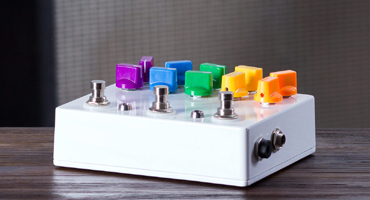
will need to use a distortion pedal. There are literally hundreds of
choices. There are warm blues pedals, death metal pedals, Jimi Hendrix
fuzz face pedals, pedals with real tubes in them. The most popular is
probably the Boss DS1, but it is not the best by any means. You really
have to try them our for yourself to find the tone you are trying to
achieve. That is why we recommend trying to achieve it from your guitar
amplifier first. Popular pedals include the Fender Blender , MXR +, ProCo Rat, Danelectro T-bone , Ibanez
Tube Screamer, Boss Metal and Super Overdrive, Rocktron , Marshall Bluesbreaker,
Arbiter FuzzFace and others.
Why Overdrive Happens
Overdrive or Distortion happens because a guitar amplifier really has 2
stages of amplification. A preamp stage and a power amp stage. By
turning the volume of the preamp stage all the way up, we are
overloading the input of the power amp stage and causing it to
distort. The effects of this are not always desirable and the tone or
timbre of the distortion achieved may or may not be the type you are
looking for. The volumes that we set in each stage of amplification is
altogether called the "gain structure". There are many different
sounding distortions that can be achieved by overloading the amplifiers
in different ways, with different types of components.
Early guitar amp tech
In the beginning, all amplifiers use vacuum tubes in their circuits.
They were not designed to be overdriven, but many guitar players
accidentally found out that if they set up the gain structure in
different ways, they could get a cool new sound. Sometimes it was a
crunchy tone that seemed to swell up and growl just when they played
hard. Sometimes it was a constant warm fuzz that bathed every note in
glorious sax-like harmonics. Sometimes it was a clear, bell-like sound
that had subtle pleasant overtones not existing in the original
guitar's timbre. These tubes, which were the heart of the
amplification process, had a way of pleasantly surprising you when you
tried to turn the volume up too loud or force an already loud signal
through them.
Today's Technology and Guitar Amps
Today, virtually all electronics that need to amplify sound, from car
stereos to televisions and ipods, do not use tube technology to do it.
They use newer technology like transistors and microchips. But many
guitar amps still use tubes because of the pleasant overdrive and
harmonic overtones generated by them. Less expensive amps use the
transistor technology and overdrive is still achievable with these
amps, but the tone is better from tube amps by far. So much so that
many digital amplifiers emulate different tube overdrive sounds. Some
guitar pedals have real tubes in them and some such as the Behringer V-tone use digital circuits
that emulate tube distortion . The classic amplifier distortion sounds
that everyone tries to emulate are the Fender (6V6 tubes, crunches when
played hard, dirty when fully overdriven, warm harmonic overtones when
clean), Marshall (EL34 tubes, sweeter lead overdrive tone at loud
levels, good bass response and crunch even when driven hard), Vox
(Heavily biased tubes, similar to Marshall but sweeter overtones and more mellow distortion).
Many computer recording programs also have distortion and amplifier
emulation algorithms but it is recommended to get the desired sound
from the guitar and amp before recording.
Distortion and Playing Technique and the Power Chord
When playing a guitar with distortion, it is important to know how
distortion affects the sound of single notes compared to chords. Single
notes will be heard clearly and the pitch of the note played should be
accurate to the instrument itself. However, chords played through
distortion will contain inter-modulated notes which may or may not
sound good. An intermodulated note is another tone that is created by
the distortion in addition to the notes that you played. The amount or
type of distortion will determine the volume of these inter-modulated
notes. They may not be in tune with the chords played and the more notes
played in the chord, the more inter-modulated notes there will be. This
often sounds very cool, especially when chords are kept to a maximum of
2 or 3 notes. When chords of 6 notes are played however, the results
are usually muddy and undesirable. This is what gave rise to the
infamous "Power Chord". Rock bands started playing two note chords that
were an interval of a perfect 5th. I.E. a G and a D, or an E and a B.
These 2-note chords, when distorted, produce an intermodulatory note
that is pleasantly in tune with the chord. So it doesn't wash out the
other instruments in the band and muddy up the song or throw off the
singer's pitch, or make the audience feel like they're hearing a jet
plane take off in the background. Of course multi-note chords and
distortion can be super cool at times, but you have to pay attention to
the sound coming out of the amp and you need to keep your distortion
settings in check so you can duplicate the sound later. otherwise that
chord progression for the song you wrote in the garage with the
Marshall Stack may not translate as well to your blues combo in your
bedroom the next day.
For single notes and solos, use the distortion to your advantage. You
should have more sustain to hold notes longer and really milk them with
vibrato and bends. Distortion will really accentuate the harmonics that
you make when you attack the strings with your pick at different angles.
there is a certain compression that happens with most types of
distortion that will also accentuate sounds such as fret noise and
finger or pick tapping on the body of the guitar or pickups.
Tone and Distortion
Distortion affects different audio frequencies in different ways.
Guitars have a fairly limited frequency range compared to many
instruments. Most of the sound of the guitar happens in what we call
the "mid" frequency range. Similar the range of a human voice. Not too
much bass and the upper range doesn't get to high. Most types of
distortion, especially the kind you achieve by overdriving the power
amplifier stage of your guitar amp, accentuates the mid range. The bass
often becomes muddy or flat anf the highs get a little dull. Distortion
pedals usually overcome this with some sort of tone circuit and most
amps have tone controls that you can use to mitigate this. Be aware
that you are changing th tonality of the guitar when you overdrive the
amp and use the tone controls to get the sound you desire.
|